
Direct Answer
AnyLeak provides leak and moisture detection services in British Columbia using non-invasive methods — acoustic correlation, tracer gas, thermal imaging, and moisture metering — to find leaks without digging or damage. Every inspection includes a written, insurance-ready report. Call (604) 269-5325 for a free phone consult.
🔄 Reviewed and maintained by the AnyLeak team — October 2026. Rated 5 stars by BC customers.
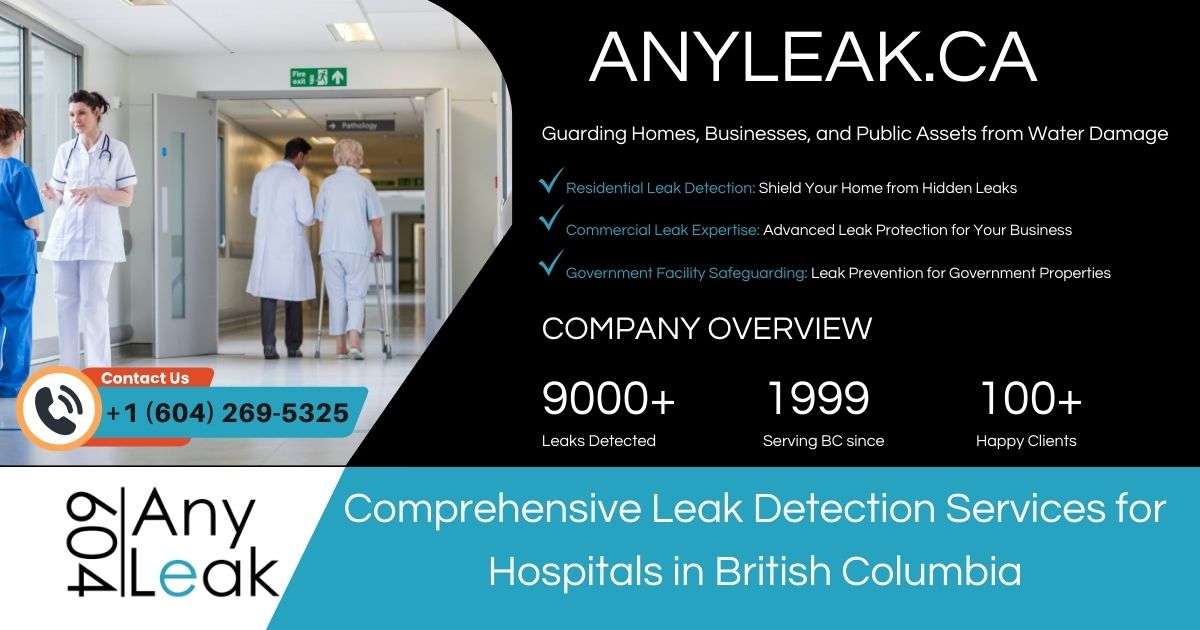
Hospitals and healthcare facilities cannot treat a water leak like an office building can: care continues around the clock, sensitive areas cannot tolerate dust or demolition, and moisture itself is a clinical risk long before it becomes a structural one. AnyLeak.ca locates hidden water in healthcare environments the way facilities teams need it done — non-invasively, quietly, on the facility’s schedule, and documented. We have pinpointed leaks in occupied BC buildings since 1999.
Why leaks are different in healthcare buildings
- Moisture is a clinical concern. Damp materials support mould and compromise hygienic environments — early, precise location protects more than the building fabric.
- No exploratory demolition. Cutting walls on a guess creates dust, noise and access problems that patient areas cannot absorb. Pinpointing first means one targeted, containable opening.
- Complex, redundant systems. Medical gas, domestic, heating, sterilization and fire lines share ceilings and shafts — identifying which system is leaking is half the diagnosis. We locate the water; your contractors and in-house trades repair under their own protocols.
- Continuous operation. Shutdowns are planned events. Accurate location shrinks both the shutdown footprint and its duration.
How we work inside a healthcare facility
Our methods are non-invasive and quiet by design: thermal imaging reads moisture behind finishes without contact; acoustic detection pinpoints pressurized-line leaks through walls and slabs; tracer gas finds the quiet breaches; moisture mapping measures exactly how far water has travelled. We coordinate access with facilities management, work within the controls your infection-prevention team specifies, schedule around clinical activity, and keep the work area small because the location is precise.
Where hospital leaks hide
- Above ceilings in occupied wards — domestic and heating lines; symptoms appear far from sources, as in any large building; see correlation methods for long runs.
- Mechanical floors and risers — the same systems we trace in high-rise buildings, at institutional scale.
- Slabs and interstitial spaces — located with acoustic and tracer methods before any coring; concrete scanning clears rebar, conduit and post-tension before penetrations.
- Flat roofs and podium decks — scanned with drone thermal imaging without foot traffic over occupied wings.
- Buried services across the campus — water mains and distribution located with underground methods and utility locating.
Documentation for institutional decision-making
Healthcare facilities answer to boards, insurers and regulators, so findings need to be in writing: the located source, the affected extent, the method used. Our reports support insurance claims, capital-planning conversations and contractor scoping — the same documentation discipline we bring to government and institutional buildings.
Beyond hospitals
The same approach serves long-term care homes, clinics, surgical and diagnostic centres, laboratories and medical office buildings — anywhere care and operations cannot pause for a water hunt. For schools and other public facilities, see school leak detection; for the broader institutional practice, see commercial and government services.
Where we work
We serve healthcare facilities across Metro Vancouver, the Fraser Valley, Vancouver Island, the Sunshine Coast and the Okanagan — see all service areas.
Frequently asked questions
Can you work in occupied patient areas? Detection is quiet and non-invasive; we coordinate timing and controls with your facilities and infection-prevention teams so clinical activity continues.
Do you repair the leak? We locate and document. Repairs proceed under your own contractors and facility protocols — which is usually exactly how healthcare organizations want it divided.
Can you find a leak without a shutdown? Location work usually needs no shutdown; isolating a system briefly for confirmation is scheduled with your team where required.
How fast can findings reach our insurer? The written report follows the site work promptly and is built for adjuster use; start with a free phone consult.
Facilities team facing recurring moisture? Call (604) 269-5325 for a free phone consult or request a site assessment.
A Closer Look at This Service
Hidden water is the most common source of expensive damage in British Columbia homes and buildings. It works silently for weeks or months, and by the time it becomes visible, the repair bill is measured in thousands rather than hundreds.
The best detection work is done by people who have seen the region’s buildings and buried systems fail in every common way. That experience is what turns a set of readings into a confident, cross-verified answer.
You do not need to prepare anything except access to the relevant areas. The technician will ask where the indicators are, which systems have been worked on, and what the history shows, and the answers shape the plan.
How the Investigation Is Delivered
Every investigation follows the same disciplined sequence: consultation, survey, testing, cross-verification, marking, and documentation. The sequence is deliberate, and each step builds on the last.
- Step 1: Consultation to understand the situation and the history
- Step 2: Site survey and indicator mapping
- Step 3: Testing of the suspected systems with matched methods
- Step 4: Cross-verification of the finding
- Step 5: Marking and documentation
- Step 6: Written, dated report
The second most common mistake is repairing the symptom. Patching the drywall, repainting the ceiling, or sealing the visible crack does not stop the water; it hides it. The water finds the next weak point, and the pattern repeats.
What This Costs
Pricing for this service in British Columbia depends on the scope of the investigation: the systems to be tested, the size of the property, and whether the finding is confirmed with a second method. A fixed quote is provided before any work begins, so there are no surprises on the invoice.
The comparison that matters is not detection cost versus no cost; it is detection cost versus the cost of an undetected leak. One targeted repair, guided by an exact location, almost always costs less than exploratory work and repeated damage.
Insurance and Documentation
For BC policyholders, the practical value is speed: the claim starts with the report already in hand, instead of weeks of back-and-forth while the insurer tries to establish what happened.
The report also protects the policyholder. When the cause is documented at the time of the loss, there is no later dispute about what was found, when it was found, or what the condition was.
What the Report Includes
The report is written in plain language first and professional language second. Owners read the conclusion and the cause; contractors and adjusters read the method notes and the readings. Both are in the same document.
You keep the report. It documents the finding, the condition at the time of the investigation, and the guidance for the repair, which is useful for warranty, insurance, and future reference.
When to Call
Call when a decision needs documentation: an insurance claim, a real estate transaction, a strata dispute, or a warranty process. Those decisions run on evidence, and the evidence has to exist before the deadline.
Call before the damage becomes visible if the meter is moving with everything off. That reading is the earliest and cheapest moment to act, and acting early is what makes the repair small.
How to Prepare the Property
Clear access to the meter, the main shut-off, the water heater, and the areas showing indicators speeds the investigation. A cleared path saves the technician’s time, which is your time on the quote.
Clear access to the meter, the main shut-off, the water heater, and the areas showing indicators speeds the investigation. A cleared path saves the technician’s time, which is your time on the quote.
Common Questions
Is this service non-invasive?
Yes. Every method used works from the surface and leaves no marks. Nothing is cut, dug, or permanently marked during the investigation.
How accurate is the location?
With cross-verified methods, locations are typically within a metre or less, and slab locations within inches.
Is the report useful for insurance?
Yes. The report documents the cause, the extent, the methods used, and the readings, structured for claims and engineering review.
How long does an investigation take?
Most property-level investigations complete within a day, and the written report follows within one to two business days.
Do you repair leaks?
No. Detection and documentation are the service. The report guides the repair contractor to the exact location.
What does this cost?
The quote is fixed before work begins, based on the scope defined in the free consultation. What you are quoted is what you pay.
Call (604) 269-5325 or email info@anyleak.ca for a free consultation. The report is dated, documented, and written to the standard insurers and engineers expect.
★★★★★
"Our flat roof developed a leak, and Anyleak responded quickly. They completed a temporary repair right away."
Sorin Silivestru
Google Review